
Choose crown height and front support
A tall crown and a supported front are different choices. Describe both explicitly in your brief and supply a profile reference with the brim visible. If your audience prefers a lower fit, do not assume that requesting a structured cap automatically communicates it. Sample review should compare the forehead profile, top shape and rear fit as a complete silhouette.
Choose one priority if your references conflict: a firm upright front, a low forehead profile or a particular rounded top. Explain that priority in the brief. During review, place the sample beside the reference and compare matching camera heights; a high camera angle can make a taller crown seem deceptively shallow.
Position embroidery across the front panels
Send editable artwork with intended dimensions rather than asking for a large logo. Review its relationship to the brim seam and crown seams. An embroidered wordmark may need simplification at smaller sizes; dimensional treatments need their own feasibility discussion. Ask to approve a decorated sample before committing the layout to production.
A centered graphic is not always visually balanced simply because its outer box is centered. A wordmark with a heavy symbol on one side may require optical adjustment. Mark both the intended center and the artwork boundary on your placement drawing, and confirm the final appearance on the finished structured crown.

Inspect the material character and how it meets stitching and decoration.
Generated design study; inspect the physical sample before approval.Specify twill, trims and the full colorway
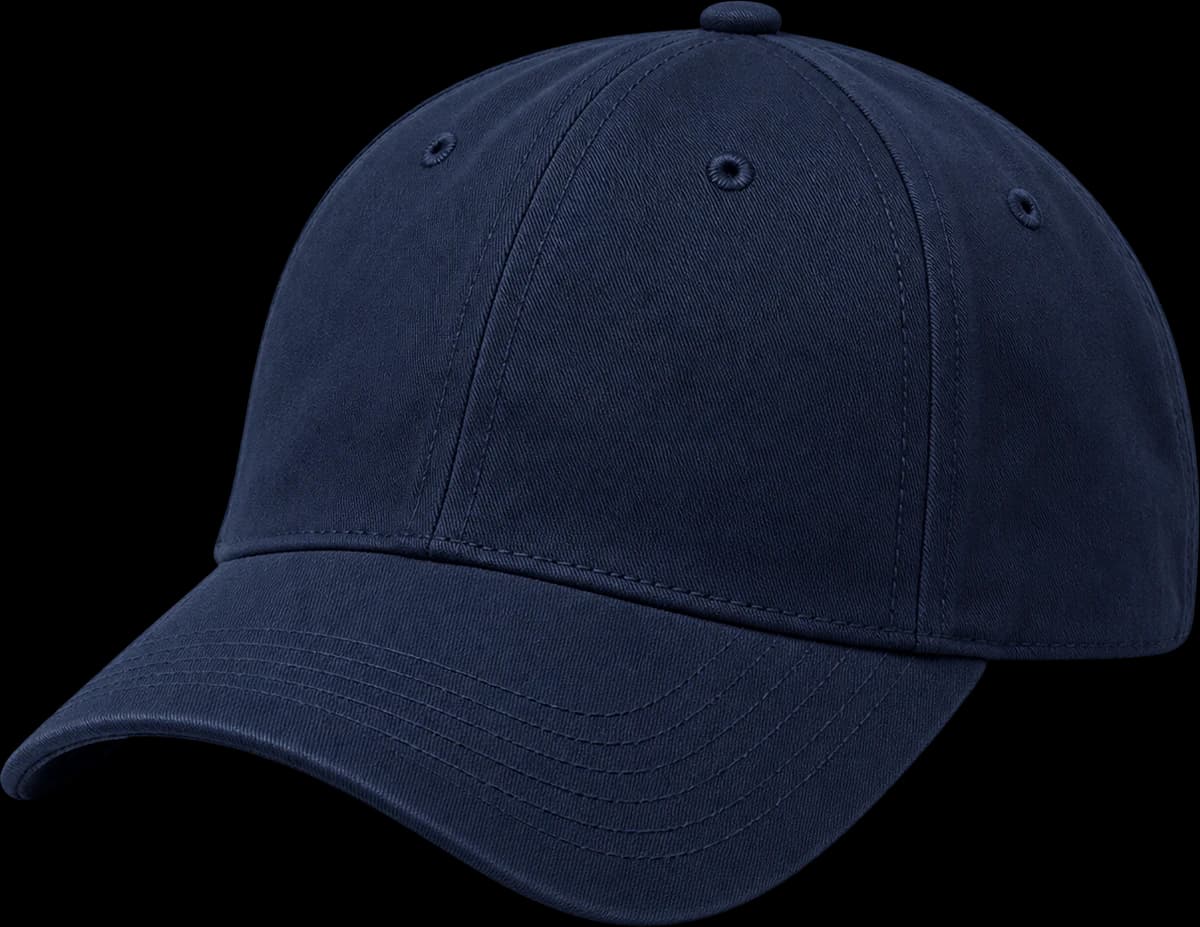
List crown, brim, underbrim, eyelets, closure and thread colors. A navy cap with a cream mark can look very different with a matching or contrasting underbrim. Reference the complete combination as one finished colorway when assigning quantities. This makes the quote and approval conversation more precise.
Specify whether stitching should disappear into the twill or become a visible outline. Contrast brim stitching can compete with a carefully restrained front logo. Review the cap without the collection moodboard beside it as well; this helps reveal whether the product still reads as the intended uniform when worn independently.
Inspect the decorated crown and visor
Inspect the finished cap from the front and both profiles. Check crown symmetry, the curve of the brim and the visual center of the logo. A flat fabric swatch or embroidery strike-off does not establish the finished silhouette. Keep the approved decorated sample and its written specifications as the reference for the order.
Check the crown immediately above the brim for uneven tension and examine the top from above. Then wear the sample at the intended adjustment. Write down whether an issue concerns firmness, dimensions or stitching rather than describing everything as a shape problem. That distinction makes the requested revision much more actionable.

Start with the overall proportion, crown shape and artwork scale.
Generated design study; inspect the physical sample before approval.A practical buying example
Suppose a teamwear cap needs a firm front but a relatively compact profile. Send a side reference for height and a separate note requesting front support. On the sample, compare the front-to-brim junction before deciding to lower the whole crown. If the issue is an upright forehead rather than excess depth, a broad instruction to “make it smaller” could alter a fit you already like. Keep the artwork dimensions in the same review record.
Questions to settle before requesting a sample
A structured cap suits a clear front silhouette; it may not give the collapsed, casual appearance of a dad cap. Before ordering, ask which sample establishes front firmness and how the finished logo sits across the center seam. Inspect the crown from above as well as straight on. A symmetrical front photograph does not reveal every change to top shape or side profile.